
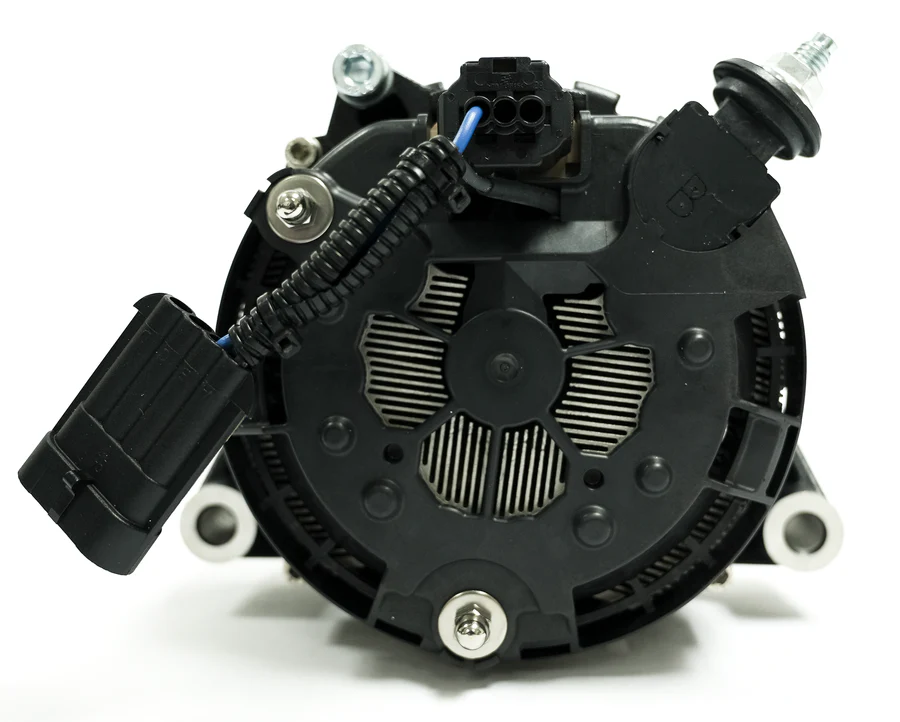
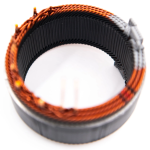
The ARCO Zeus A8000-48V alternator turns on at lower RPMs, runs cooler and provides more power than other 48V alternators that are larger and heavier. This alternator continuously generates over 3kW (55 Amps) 2,500 RPM, and almost 6kW (111 Amps) at 4,000 Alternator RPM. Put in real world terms, a marine diesel engine charging at 1,200 RPM with a 3.13:1 pulley ratio is generating just over 5kW (97 Amps), and a Mercedes Sprinter at 750 RPM with a 3.21:1 ratio is generating over 3kW (55 Amps)!
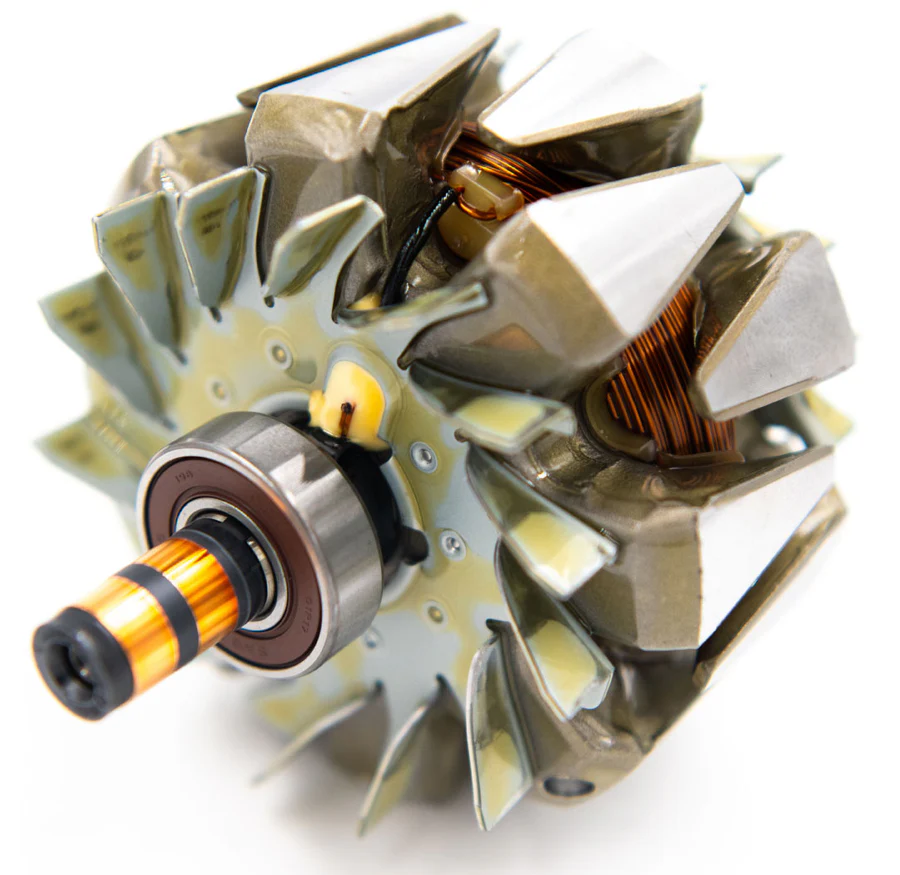
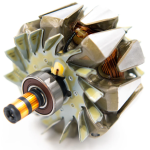
Instead of using rotors designed for 48 volts, many competitor’s alternators simply use their 12V rotors which is less efficient and limits output at all RPMs. In this scenario, your external smart regulator must drastically reduce field, by as much as 78%. If this is not done correctly, you run the risk of destroying the unit and damaging other components in your system. ARCO utilizes a native 48V rotor and field current. This results in our 48V alternator running cooler than competitor’s 48V alternators, having a direct impact on the alternator’s lifespan.
Optimize your alternator’s output with the ARCO Zeus Bluetooth Alternator Regulator.
| oltage | 48V |
| Field Type | P |
| Rotor Poles | 16 |
| Rotator Source Voltage | 48V |
| Stator Size | 138mm |
| Frame Size | Large |
| Weight of heaviest option (N62 with clutch pulley) | 15.89 lbs / 7.2 kg |
| Regulation | External Only (EX) |
| Finish | (Black) E-coating |
| Cut-In RPM | 1,920 Alternator RPM |
| Maximum Alt RPM | 19,000 |
| Battery Post | M8 Thread Post, Side Mount |
| Standard Pulley | 49K6 (6-groove, 49mm) |
| Pulley Mount | 17mm diameter shaft, 25mm long, threaded M17 x 1.5 |
| Pulley Hardware | M17 x 1.5 x 24mm nut, w/ 18mm ID x 29mm OD washer (Included) |
| Diodes | 6 positive, 6 negative, 80A Rated, Avalanche |
| Max Output (Cold, 9,000 RPM) at 53.5V | 9,630 Watts – 180 Amps – 14.80 kW PTO |
| Sustained Cruising Output (Hot, 6,000 RPM) at 53.5V | 7,383 Watts – 138 Amps – 10.5 kW PTO |
| Sustained Idle Output (Hot, 2,500 RPM) at 53.5V | 4,173 Watts – 78 Amps – 6 kW PTO |
| Max Continuous Operating Temperature | 100°C / 212°F |
| Mounting | ARCO Part Number | Application |
| 1-2” Single Foot | 4605 | Replaces most domestic styles using a single 1 or 2” mounting foot (e.g., Motorola, Prestolite). |
| 3.15” J180 Saddle | 4601 | Replaces most small case styles using a 3.15” J180 saddle style mount (e.g., Hitachi, Lucas, Mitsubishi) Most Yanmars. |
| 3.15″ R Saddle Mount, Rear Exit B+ | 4602 | Must Be Used on Yanmar Common Rail Engines Introduced after 2013 (JH-CR, 3JH40, 4JH45, 4JH57, 4JH80, 4JH110). |
| 4” J180 Saddle | 4603 | Replaces most Volvo Penta alternators using a 4” J180 saddle style mount. Also use on many larger industrial-based engines. |
| Vortec/GM | 4606, 4609 | Replaces Mando type alternators using Vortec/GM pad mounting feet (Found on many Mercruiser and Volvo Penta 3.0GLM, 3.0GLP, 4.3GXi, 5.7GiL, 5.7GXiL Marine Engines). |
| N62 (Clutch Pulley) | 4604 | Replaces factory dual alternator on many Sprinter RVs, including Roadtrek, Thor, Winnebago, and others. For all Mercedes Sprinter applications with N62 option. Meets current Mercedes Upfitter weight and PTO requirements. |
| Transit | 4607 | Ford Transit Dual alternator 3.5L & 3.7L Gas engines 2015-2022 replacement. |
Isolated ground only for marine units.
External Only (EX): These units will come with a terminal block and a P-Type harness. They will only work with an external regulator, such as an ARCO Zeus Bluetooth alternator regulator.
To measure sustained output, the alternator is run at 3,000 RPMs for 60 minutes with a plexiglass shield covering the units. Testing shows that after 60 minutes in these conditions, alternators reach their maximum operating temperature, or the conditions under which the unit will produce the least output.
It is under these harsh conditions where we measure the “hot” output of the units at various RPMs. The complete power curve is shown above.
Note: The “hot” conditions are much less favorable than the conditions typically used in the industry. The temperature of the stator during our “hot” test was 305 °F. Incumbents measure the power curve at an ambient temperature of 140 °F. “Cold” testing was done at 71° F.
| ARCO Zeus 24V 7kW | APS | Mechman | Balmar |
| 4601, 4602 | 360HSB1H652S9E4 | – | – |
| 4603 | 42I-270-14JEXT/STA | – | – |
| 4604 | 360HN621H652S9CE4 | – | – |
| 4605 | – | – | – |
| 4606 | – | – | – |
| Voltage | Maximum Output (Watts) | Sustained Idle Output (Watts) | Housing | Regulation | Pulley | Unit Part # |
| 48V | 9,630 (180) | 4,173 (78) | Transit | External Only | 49mm K6 | 4607 |
| 48V | 9,630 (180) | 4,173 (78) | Vortec (GM) | External Only | 49mm K6 | 4606 |
| 48V | 9,630 (180) | 4,173 (78) | 1″-2″ Single Foot | External Only | 49mm K6 | 4605 |
| 48V | 9,630 (180) | 4,173 (78) | N62 Clutch Pulley | External Only | 50mm K6 Clutch Pulley | 4604 |
| 48V | 9,630 (180) | 4,173 (78) | 3.15″ J180 | External Only | 49mm K6 | 4601 |
| 48V | 9,630 (180) | 4,173 (78) | 3.15″ J180 Common Rail | External Only | 49mm K6 | 4602 |
| 48V | 9,630 (180) | 4,173 (78) | 4″ J180 | External Only | 49mm K6 | 4603 |

The ARCO Zeus A8000-48V is a 48V high-output alternator that makes up to about 9.6 kW. That is enough to recharge a large 48V house bank from the engine. It uses a native 48V rotor, rather than a 12V rotor pushed to 48V, so the regulator is not fighting the alternator to hold voltage down.
Ratings are at 53.5V and at the alternator shaft (engine RPM × pulley ratio):
| Peak, cold (9,000 alt RPM) | 180 A (about 9.6 kW) |
|---|---|
| Sustained hot, cruising (6,000 alt RPM) | 138 A (about 7.4 kW) |
| At 4,000 alt RPM | about 111 A (almost 6 kW) |
| At 2,500 alt RPM | about 55 A (over 3 kW), continuous |
| Starts charging at | about 1,920 alt RPM |
| Max continuous operating temperature | 212°F (100°C) |
From ARCO’s examples: a marine diesel at 1,200 RPM with a 3.13:1 pulley ratio gets just over 5 kW, and a Sprinter at a 750 RPM idle (3.21:1) still gets over 3 kW.
External regulation only: it needs an external regulator such as the ARCO Zeus regulator, which also handles lithium charge profiles. This listing’s default housing is the 3.15″ J180 saddle with an isolated ground (ARCO part 4601); other housings are in the options above. Not sure 48V is right for you? Read 24V vs 48V: which is right?
Choose the housing that matches the alternator you are replacing:
| 1–2″ single foot | Most domestic single-foot alternators (e.g. Motorola, Prestolite). |
|---|---|
| 3.15″ J180 saddle | Most small-case saddle alternators (e.g. Hitachi, Lucas, Mitsubishi) and most Yanmars. |
| 3.15″ saddle, rear-exit B+ (common rail) | Required on Yanmar common-rail engines after 2013. |
| 4″ J180 saddle | Most Volvo Penta 4″ J180 mounts, and many larger industrial-based engines. |
| Vortec / GM pad | Mando-type alternators with Vortec/GM feet (many MerCruiser and Volvo Penta gas engines). |
| N62 with clutch pulley | The factory second alternator on many Sprinter-based RVs. |
| Ford Transit | Ford Transit dual-alternator setup, 3.5L and 3.7L gas, 2015–2022. |
Not sure? Send us a photo of your current alternator’s mounting feet and we will match it.
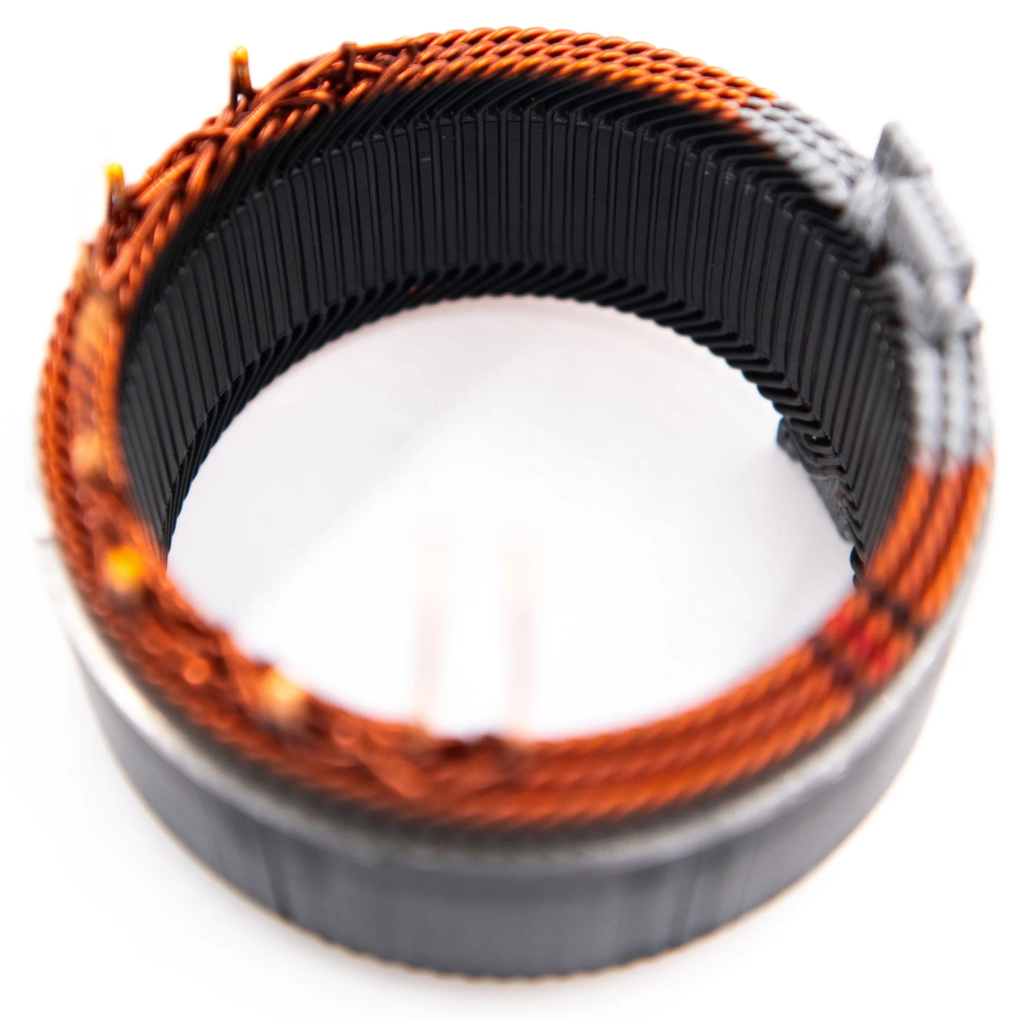
Like every Zeus alternator it is built in the USA by ARCO Marine of Pensacola, Florida, and is SAE J1171 certified (ignition-protected for marine engine rooms). Inside: a 16-pole rotor, a large-frame 138 mm stator, dual cooling fans and avalanche-rated diodes, with the rectifier outside the housing to keep heat away from it.
Planning a 48V system? Call us on (410) 216-2907 or start with the Power Guide.